Overview


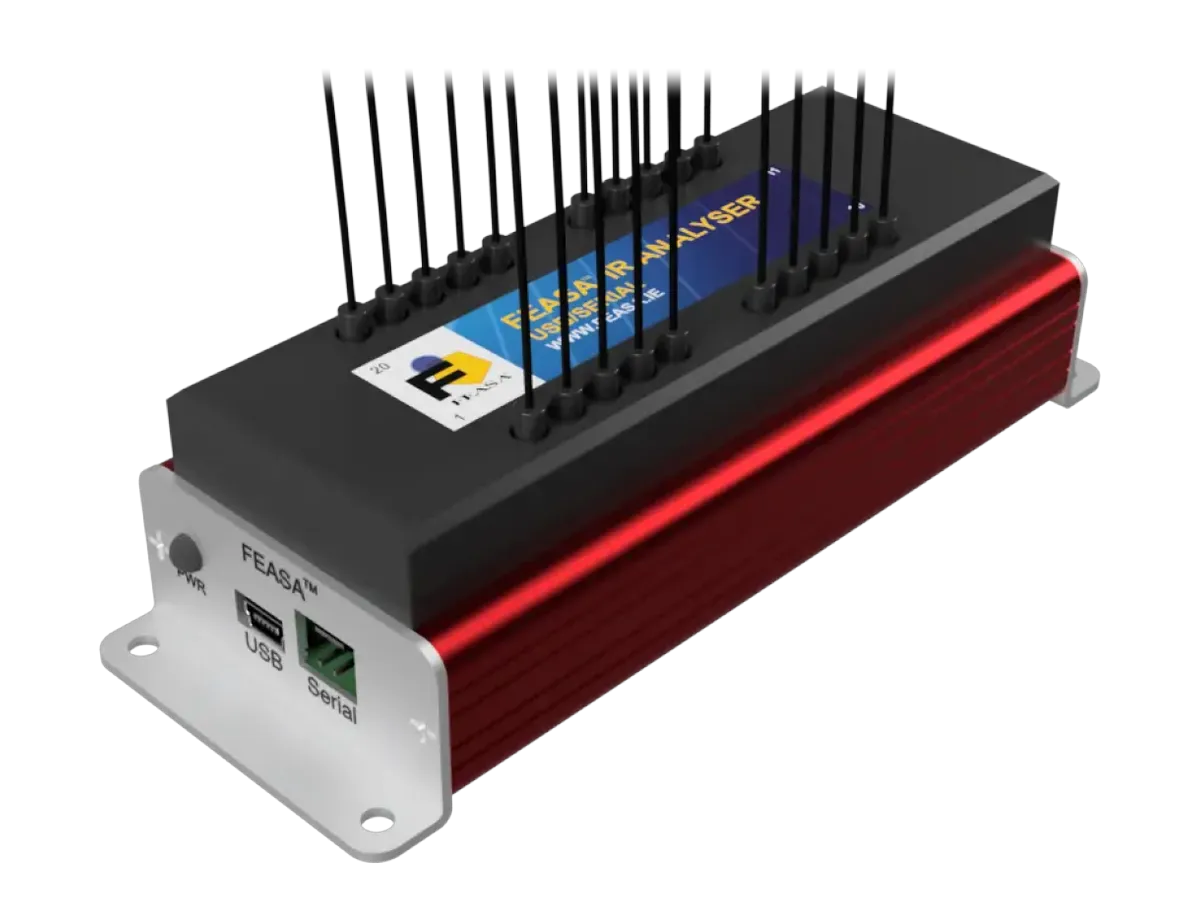
The Feasa Infrared LED Analyser is a multichannel instrument for fast, repeatable wavelength and intensity measurement of infrared LEDs in production. Operating across 700–950nm, it's trusted across automotive sensing, security and industrial applications worldwide.
Unlike visible LEDs, infrared devices must be verified using dedicated optical measurement techniques. The Infrared LED Analyser provides accurate wavelength and output measurements, ensuring every device performs as intended.
Supporting multiple channel configurations and a choice of optical fibres, it integrates easily into automated production systems while delivering fast, reliable infrared LED measurements.
Built for infrared. Trusted globally.

Dedicated 700–950 nm infrared testing
Test infrared LED output across the 700–950 nm range for applications where visible-light analysers are not suitable.

Comprehensive output parameters
Outputs include infrared wavelength and relative intensity, giving you the data needed to make pass/fail decisions.

Complete software package
The full Feasa Software Suite is included as standard, with DLL and programming examples for LabVIEW, C, C++, C# and Python.

Built for production integration
USB and RS232 interfaces are standard, with up to 30 analysers daisy chained from a single port.

Proven in production
- Millions of LEDs tested every day using Feasa products
- Worldwide usage on production lines by leading manufacturers

Direct engineering support
From fixture integration and setup to troubleshooting, our technical team supports you throughout deployment.
Applications
Where our Infrared Analyser is commonly used.


Technical Specifications
| Parameter | Value | Notes |
|---|---|---|
| Channels | 3, 10, 20 | Simultaneous measurement |
| Wavelength range | 700–950 nm (glass) / 700–900 nm (plastic) | |
| Wavelength accuracy bands | ±30 nm (700–750) · ±10 nm (751–900, best band) · ±30 nm (901–950, glass only) | |
| Repeatability — wavelength | ±1 nm | |
| Intensity repeatability | <1% | |
| Supply voltage | 5.0V | |
| Supply current | 220 mA | |
| Dimensions | 104.5 × 54 × 39 mm / 145 × 54 × 39 mm | |
| Fiber length | 0.6 m | |
| Fiber diameter | 1.1 mm (glass) / 1.0 mm (plastic) | |
| Min. bend radius | 50 mm (glass) / 15 mm (plastic) | |
| Operating temperature | 0–50°C | |
| Interface | USB, RS232, Daisy Chain, Ext. Trigger | |
| Compliance | CE, RoHS | |
| Model / order codes | 3IR·10IR·20IR / 3IRP·10IRP·20IRP |
Feasa Terminal + User Gains Software

Both included with every analyser
- Feasa Terminal — Command-line control with script processor and command save/recall
- User Gains Software — Automatic or manual per-channel intensity adjustment
- Saved adjustments — Adjustments saved to file and recalled on subsequent sessions
- LabVIEW drivers — Provided for NI platform integration
- DLL — Custom testing integration in C, C++, Python
- Connectivity — USB and RS232 compatible — Daisy Chain for multi-unit systems
Downloads and Resources